PRIVATE EYE & NICK COHEN
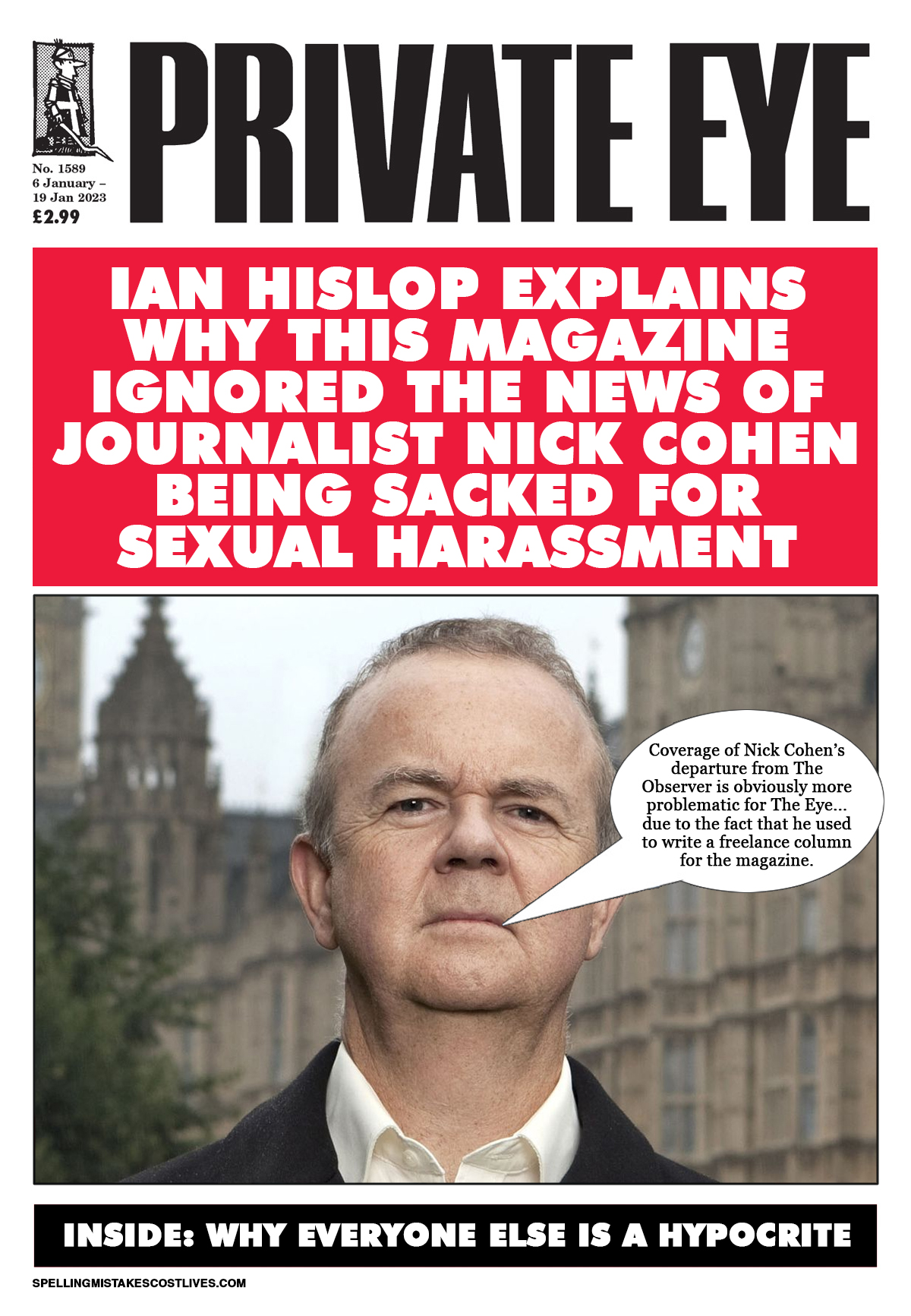
Had to make this today after reading that (genuine) quote from Ian Hislop, editor of Private Eye.
Nick Cohen has been a known creep for decades. He got his nickname “the octopus” due to how frequently he’d grope female colleagues, safe in the knowledge that his power and prestige would protect him
Cohen’s political views are also rancid: he pushed for the Iraq war, is pro-Israel, anti-trans and hates the left, and would write about all these things in The Observer, The Spectator and Private Eye.
The following is from a New York Times article by Jane Bradley about how a Financial Times article about these allegations was spiked to protect both Nick Cohen and The Observer/Guardian
(The full thing can be read here: https://www.ekathimerini.com/nytimes/1212221/a-british-reporter-had-a-big-metoo-scoop-her-editor-killed-it/ )
“His resignation in January cited “health grounds.” Secretly, the newspaper group paid him a financial settlement for quitting and agreed to confidentiality, according to three colleagues and an editor with whom Cohen spoke.
In his farewell, editors praised his “brilliant” and “incisive” coverage.
Seven women told The New York Times that Cohen had groped them or made other unwanted sexual advances over nearly two decades. Four insisted on anonymity, fearing professional repercussions. In each case, the Times reviewed documents or otherwise corroborated their accounts.
Siegle recounted Cohen grabbing her bottom in the newsroom around 2001. Five other women described similar encounters at pubs from 2008-15. One said Cohen pressed his erection against her thigh and kissed her uninvited when they met to discuss her career. A seventh said Cohen repeatedly offered to send her explicit photographs in 2018 while she worked as an unpaid copy editor for him.
Cohen’s reputation was widely known in the newsroom, according to 10 former colleagues, both male and female. One former colleague said she and other female journalists used a different entrance to a pub to avoid being groped by him. Another woman said she avoided the bar downstairs from the newsroom after Cohen grabbed her knee during work drinks.
“There is so much sexism in a lot of British newspapers, and it seems, unfortunately, that many women believed sexual harassment was something you just had to put up with,” said Heather Brooke, an investigative journalist who told the Times that Cohen groped her at an awards ceremony in 2008, before she had a high profile.
Guardian News & Media did investigate Cohen, but only after Siegle wrote on Twitter in 2021 about her experience.
Even then, it was a story few in the British news media wanted to tell. The Guardian signed a confidentiality agreement with Cohen. The Financial Times spiked its story. Even investigative magazine Private Eye did not cover his departure. When a reader emailed asking why, the editor replied: “Coverage of Nick Cohen’s departure from The Observer is obviously more problematic for The Eye than the others that you mention due to the fact that he used to write a freelance column for the magazine.”
Cohen’s departure got a mention only in The Press Gazette, a media trade website.
In a phone interview, Cohen said he did not have the “faintest idea” about Siegle’s accusation and questioned why she waited so long to report it. He said the conversation with the copy editor was “joking” among friends. He blamed their accusations on a campaign by his critics, including advocates for Russia and for transgender rights.
Informed that seven women had come forward with sexual misconduct complaints, Cohen exclaimed, “Oh, God.”
“I assume it’s stuff I was doing when I was drunk,” said Cohen…
Cohen left the newspaper and told the Times that he accepted a deal after considering the financial implications for his family, in particular his son, who has autism.
“I’m the only person whose life is turned over because of this,” he said.
The #MeToo movement was sweeping through society on February 1, 2018, when Siegle met with The Guardian’s managing editor, Jan Thompson, to report her experiences with Cohen.
Siegle had started at The Guardian around 2001 as an editorial assistant. She described standing at a photocopier when Cohen appeared behind her, cupped her bottom with both hands, grunted and breathed heavily into her ear.
Siegle remembers returning to her desk, humiliated. She never considered reporting him. “I’m literally the least powerful person in the entire newsroom,” she said.
For 14 years, as she advanced at The Observer, she said she avoided his desk and chaperoned interns “like a mother hen crossing a busy road.”
At the Feb. 1 meeting, Siegle said Thompson responded by talking about the abuse that Cohen faced for his political views, according to notes Siegle wrote afterward. She described the meeting as a “chaotic mess of defensiveness and attack.”
The Guardian spokesperson said Siegle, who was by then a freelancer for the newspaper, opted not to pursue her complaint. Siegle says an investigation was never offered. A week after the meeting, Thompson emailed to let Siegle know that she was “here if you want to discuss further.” Siegle declined.
In interviews, former Observer and Guardian managers said they knew Cohen had a drinking problem but could not remember anyone reporting sexual misconduct. “In a way, I’m puzzled,” said Chris Elliott, a former managing editor of both papers. “Because I should have heard something about it on the grapevine.”
Jean Hannah Edelstein, an assistant at The Observer from 2007-09, said Cohen was not alone in his behavior. She recalled her editor hitting her with a sex whip as she walked by. Over one boozy lunch, she said, the same editor offered to help her career and suggested she pose naked to promote her book.
Several journalists said Cohen’s reputation for groping was far from secret and five women said he groped them after work at pubs, including one who said he groped her “five or six” times in 2008.
Another woman, a freelance journalist who had recently been homeless and had depression, said she met Cohen at a pub in 2010 to discuss her career. As they chatted, she said, he suddenly kissed her on the mouth and pressed his erection against her thigh. She said she fled.
“I just remember walking along Waterloo Bridge and thinking, ‘I can’t go to The Guardian with this. Who would they believe?’” she said. “He was one of their stars and I was a freelance journalist with mental health issues.”
…
In fall 2021, Siegle wrote on Twitter about her experience. Her lawyer, Jolyon Maugham, began making noise. Thompson immediately emailed.
“Given that you have now tweeted publicly,” Thompson wrote, “I hope that it means that your position has now changed, and that you would be willing to provide further information so that we can investigate the matter fully.”
Siegle said that was misleading, that The Guardian had not offered to investigate in 2018.
Eventually, Cohen was suspended and The Guardian hired a law firm to carry out an independent inquiry. Neither Siegle nor the copy editor agreed to participate.
Cohen confirmed that he signed an agreement to leave the newspaper, but would not discuss the terms.
Ian Hislop, the editor of Private Eye, said he discussed the terms of The Guardian’s deal with Cohen, who no longer writes for Private Eye. “Instead of any conclusion,” Hislop said of the Guardian investigation, “it ended up with a secret agreement and a big cash payment.”